
Where art meets life
This is where our journey begins. Get to know Adia Elora Rothschild and what we do, and how we're committed to quality and great service. Join us as we grow and succeed together. We're glad you're here to be a part of our story.
Current Events
OCTOBER - DECEMBER 2026
WOMAN IN INTERIOR SERIES

In my Woman in Interior series, I explore the private psychological spaces women inhabit when they are removed from the expectations and observation of the outside world. These works capture women reading, contemplating, gazing outward, resting, sitting nude, or simply existing within the familiarity of their surroundings. I am interested in these seemingly ordinary moments because they reveal something deeply intimate: the self when it is no longer being consciously presented to others.
The interior becomes more than a physical setting. It represents a place of privacy, security, reflection, and psychological freedom. Within these rooms, the women are allowed to retreat into their own consciousness. Their gestures are quiet and unperformed—the resting hand, the distant gaze, the relaxed body, the moment absorbed in a book or lost in thought. Nothing necessarily needs to happen. Their interior lives are the subject.
I use fragmented forms, geometric divisions, bold contours, and saturated color to suggest the complexity beneath this stillness. The figures and their environments often merge into one another, reflecting the relationship between our internal state and the spaces we inhabit. Windows, furniture, plants, paintings, and architectural elements become extensions of mood, memory, thought, and identity.
At the center of this series is my fascination with the moments between privacy and security—when a person feels sufficiently protected to become genuinely themselves. I am not attempting to define these women through what they do for others, how they are perceived, or how they perform femininity in public. Instead, I am observing the woman who exists when no one is asking anything of her.
Woman in Interior is ultimately an exploration of solitude not as emptiness, but as presence: the private moment in which a woman belongs entirely to herself.
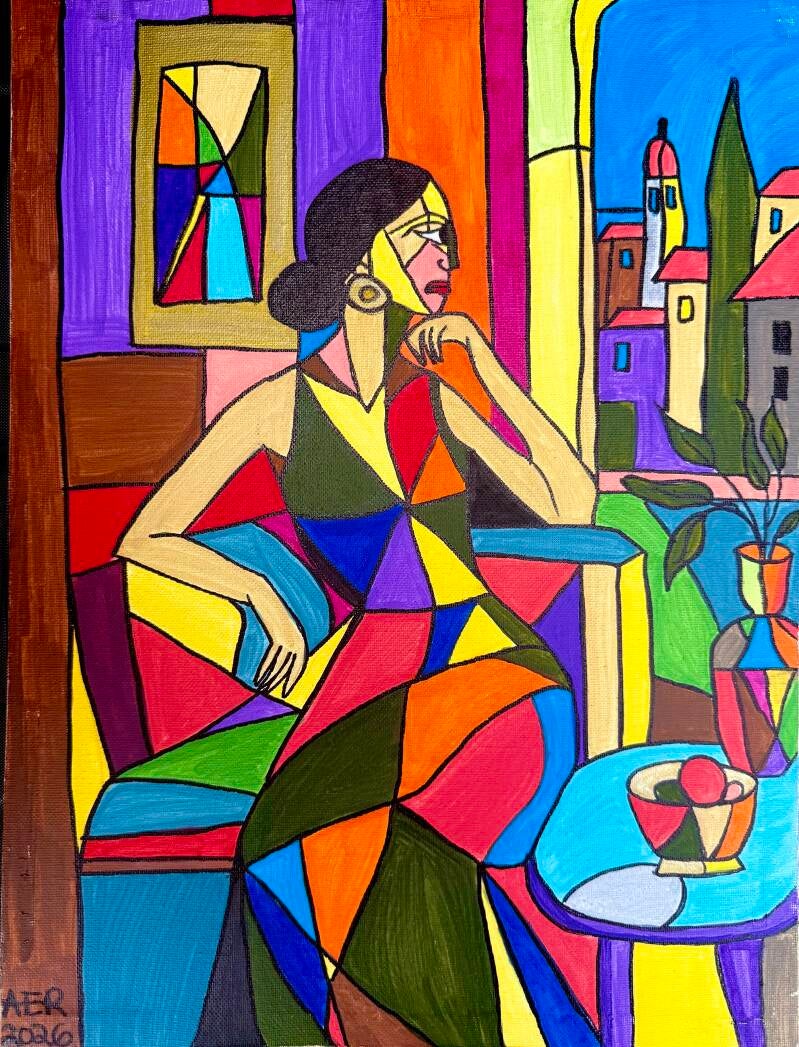
Woman Contemplating
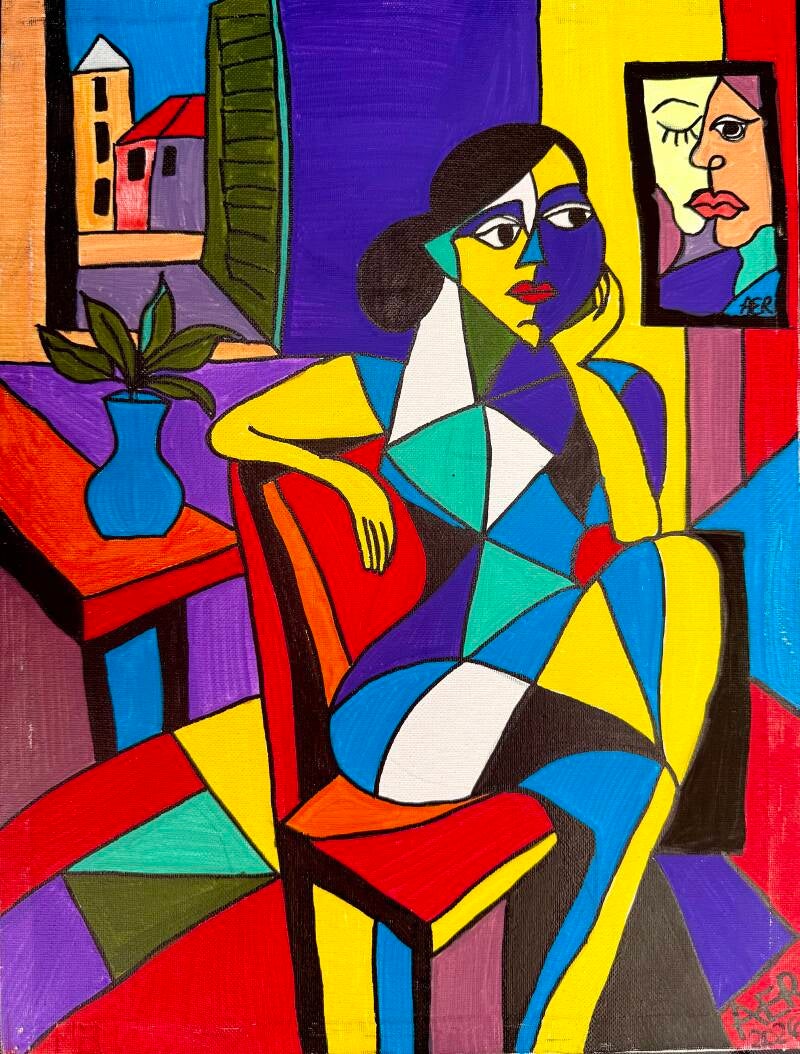
Woman Gazing
Past Events and Exhibitions
JULY - SEPTEMBER 2026
INFINITE ♾️ FRAGMENTS
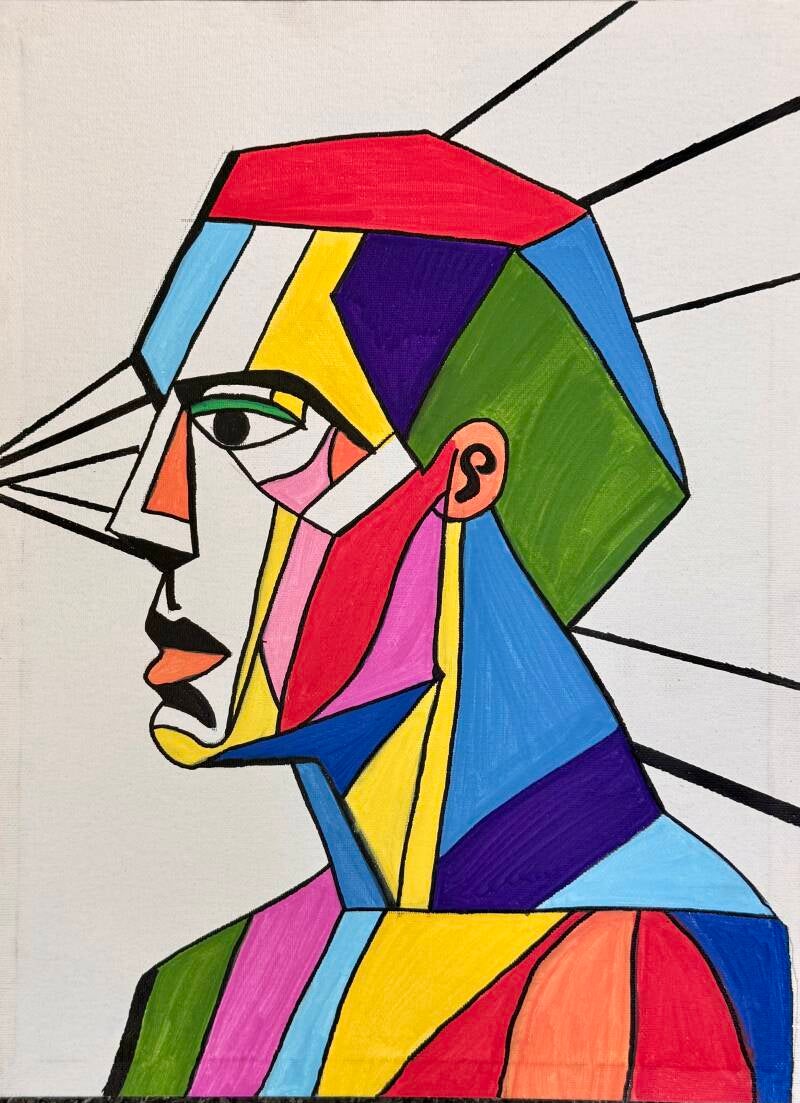
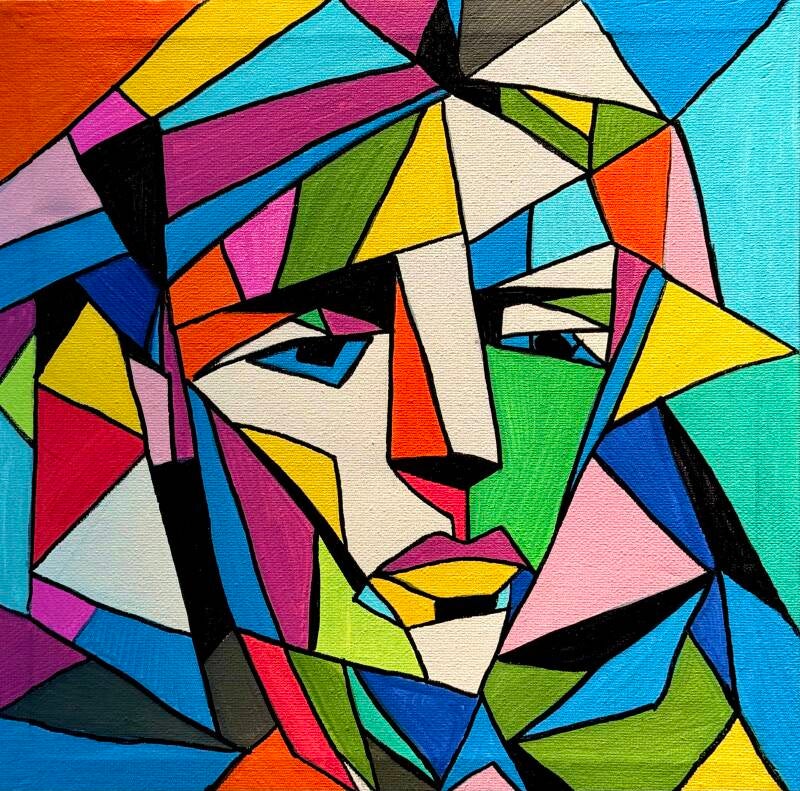
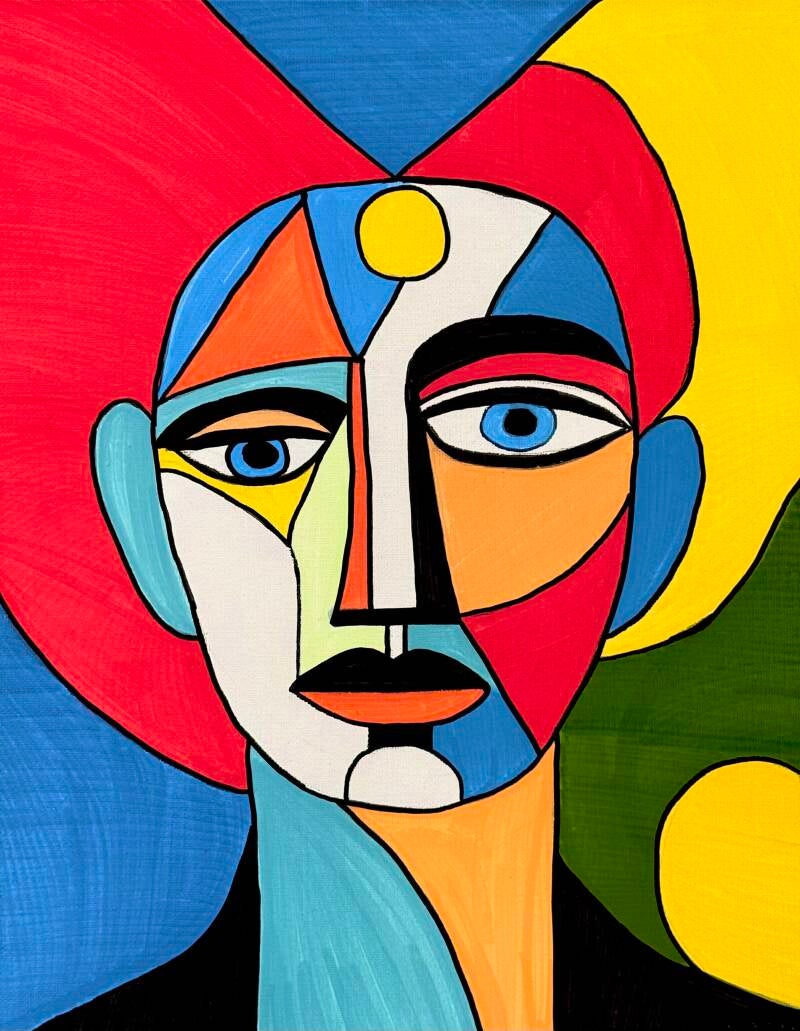
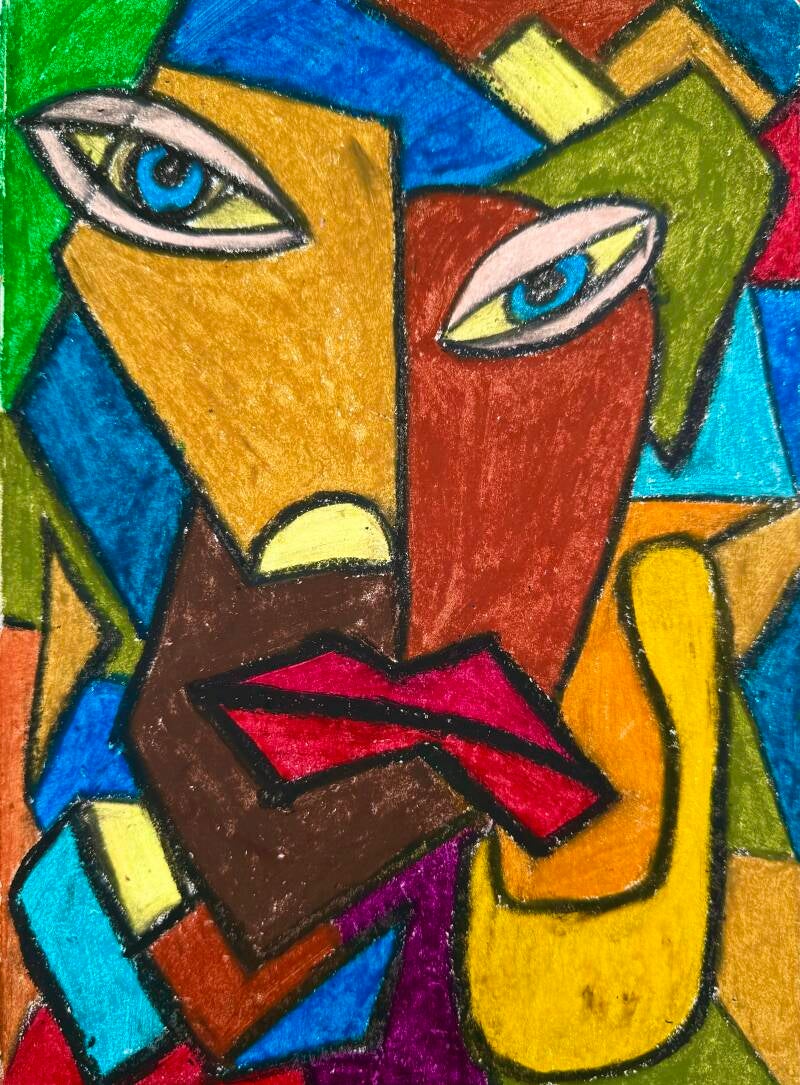
In my Infinite Fragments series, I invite viewers into the radiant chaos of inner experience. Each painting—Kaleidoscope Mind, Chromatic Mind, Veils of Perception, Faces Between, and others—emerges from my fascination with consciousness as a living prism rather than a fixed whole.
I fracture faces, dissolve forms, and weave them into exploding fields of saturated color. What appears broken is in truth multiplied: emotions, memories, perspectives, and realities overlapping in constant dialogue. Through bold acrylic strokes and prismatic palettes, I explore how perception acts as both veil and portal—revealing and concealing at once.
Most of these works are self-portraits as much as they are universal mirrors. In Chromatic Mind, consciousness refracts into interlocking facets of light and feeling. In Kaleidoscope Mind, a central face emerges and dissolves into swirling worlds within worlds. Veils of Perception and Faces Between capture the liminal spaces where identity shifts, where the self exists not as singular but as porous and interconnected. All the other paintings follow the same exploratory pattern.
I do not see fragmentation as loss. Instead, I celebrate it as our greatest strength—an infinite mosaic where beauty, power, and connection arise precisely from our multiplicity.
This series is my optimistic declaration: in embracing the shards and reflections of who we are, we become more luminous, more alive, and more whole.
— Adia Elora Rothschild
Primitive Series
Digital Ceramic Art Exhibition
FEBRUARY 01 - APRIL 30 2026

Artist Statement & Introduction
The Primitive Series emerged from an instinct rather than a plan. These works were not designed; they were formed. I approached clay not as a medium to be controlled, but as a material to be listened to—pressed, folded, punctured, and allowed to resist. In this series, I intentionally moved away from refinement and utility, toward something older, more elemental: the human impulse to shape matter into meaning.
These vessels recall objects that might have existed before language stabilized thought—before ornament became decoration rather than necessity. They resemble tools, reliquaries, incense holders, bowls, cups, and containers, yet they refuse to fully commit to any single function. Their ambiguity is deliberate. They exist in the same way early human objects did: multifunctional, symbolic, and inseparable from ritual, survival, and belief.
At the core of the Primitive Series is the idea of the vessel—not merely as an object that holds, but as a metaphor for the human condition. Each piece carries the imprint of hands, pressure, collapse, repair, and endurance. The perforations that mark many surfaces function as breaths, scars, or passages—points of exchange between interior and exterior, self and world. Nothing here is sealed. Everything is porous.
The forms often echo the body—hips, torsos, spines, mouths, wombs—without becoming literal. This is not representation, but memory. The body is not depicted; it is remembered through gesture. In this way, the work speaks to embodiment without idealization. These are not perfected bodies; they are lived-in bodies. They sag, swell, crack, and carry weight. They stand as quiet resistance to contemporary expectations of polish, symmetry, and efficiency.
Color in this series functions symbolically rather than decoratively. Earth tones and saturated pigments sit side by side like emotional strata or cultural layers. The palette reflects a collision of the ancient and the contemporary—raw mineral hues alongside bold, almost defiant modern color fields. This tension mirrors our present condition: technologically advanced, yet spiritually searching; socially complex, yet fundamentally primitive in our needs for meaning, belonging, and ritual.
Philosophically, the Primitive Series is rooted in existential inquiry. These objects ask what remains when systems fall away—when ideology, language, and hierarchy dissolve. What is left is the act of holding: holding food, holding fire, holding offerings, holding memory. The vessels do not speak loudly; they endure. They embody the quiet dignity of survival and the inevitability of imperfection.
Sociologically, the series reflects on collective identity and labor. Historically, vessels were among the first objects made communally—used by many, passed through generations, shaped by necessity rather than authorship. In reclaiming this lineage, I deliberately step away from the notion of the artist as distant creator and instead position myself as a participant in a continuum. These works do not seek to dominate space; they seek to belong within it.
The Primitive Series is also an act of refusal—against disposability, against hyper-polished aesthetics, against the demand that art justify itself through function or market clarity. These pieces exist as artifacts of presence. They could have been used. They could still be used. But their primary role is to witness.
Ultimately, this collection is about remembering what it means to be human at the most fundamental level: to shape, to carry, to endure, and to leave traces. The Primitive Series does not look forward or backward—it exists outside of time, grounded in the simple, radical act of holding space.


POPULAR BEAUTY
Digital Art Exhibition
October 01 2025 - February 28 2026
Adia Elora Rothschild’s Popular Beauty series begins from the premise that beauty is not a natural given but a cultural construct. Within contemporary life, ideals of beauty are manufactured, disseminated, and enforced through systems such as media, fashion, and digital culture. This aligns with poststructuralist thought, which views beauty not as a stable essence but as a signifier—fluid, contingent, and dependent on the structures of language and representation. In Rothschild’s work, beauty is staged and exposed as performance, echoing Judith Butler’s concept of gender performativity, in which social categories are not innate but enacted and sustained through repetition. Beauty here is not discovered but produced, a shifting agreement between image and audience.
Ephemerality and Power
Central to the series is the recognition that beauty is a fleeting category, defined as much by its temporality as by its form. What is considered beautiful today quickly becomes obsolete tomorrow, displaced by new styles, new icons, and new cultural desires. This temporality reveals beauty’s fragility: it cannot be fixed but exists only in circulation. Rothschild draws attention to this cycle of elevation and abandonment, underscoring how ideals of beauty function less as truths and more as tools of power. In Foucauldian terms, discourses of beauty regulate bodies by prescribing norms, disciplining difference, and creating hierarchies of value. In exposing the instability of these norms, Rothschild’s work destabilizes the authority of beauty itself.
Simulacra and Popular Culture
The Popular Beauty series also resonates with Jean Baudrillard’s notion of the simulacrum: beauty in the age of mass media is no longer tied to an original but becomes self-referential, endlessly replicated, and consumed. The “popular” aspect of beauty is especially significant here, pointing to its democratization in digital culture, where images circulate rapidly and ideals are perpetuated through repetition and mimicry. Yet this very proliferation renders beauty unstable, dissolving its supposed authenticity into spectacle. Rothschild’s work both participates in and critiques this circulation, revealing how beauty functions as a currency of desire, exhausted by its own ubiquity.
Conclusion: Beauty as Site of Tension
Ultimately, Rothschild’s Popular Beauty series positions beauty as a site of theoretical tension: between illusion and exposure, desire and critique, permanence and flux. Beauty is revealed not as a timeless value but as a temporary agreement—one that structures identity, informs desire, and perpetuates exclusion while constantly unraveling under the weight of its own contradictions. By foregrounding its relativity and fleetingness, Rothschild reframes beauty not as an endpoint but as a question: what does it mean to chase, construct, and consume an ideal that cannot hold still?



We offer a range of specialized art and multimedia services tailored to meet your individual needs. Our approach is focused on understanding and responding to what you require, providing effective and practical solutions in New York, New York, United States.
Professional services
What we do
Adia Elora Rothschild offers multiple arts, fashion and media services. Our approach is focused on understanding and responding to what you require, providing effective and practical solutions.

Stories told in pixels
We pride ourselves on our adaptability and commitment to excellence in every aspect of our service. Explore what Adia Elora Rothschild has to offer and how we can contribute to your success, raising brand awareness and showcasing our work.
About us
Adia Elora Rothschild's paintings all began with a simple idea fueled by a deep passion. As a small business, we pride ourselves on personal attention and dedication to every detail in New York, New York, United States. Our approach is rooted in quality and integrity, ensuring that everything we do reflects our commitment to excellence.
Socials