Primitive series
February 01 - April 30 2026
Series of hand made natural Clay ceramic pieces. The Primitive Series by Adia Elora Rothschild explores raw form and instinct through natural clay ceramics. Earth-bound, tactile, and ritualistic, each piece honors imperfection, ancient memory, and the quiet power of hand-shaped matter.
The Primitive Series by Adia Elora Rothschild is a body of natural clay ceramic works rooted in instinct, earth memory, and the intelligence of the hand. Formed without ornamentation or excess refinement, each piece embraces raw surfaces, irregular contours, and organic asymmetry as deliberate expressions of authenticity. The clay is allowed to speak—cracked, scarred, textured—revealing traces of pressure, breath, and movement embedded in the material itself.
Drawing inspiration from ancient vessels, ritual objects, and early human mark-making, the series rejects modern perfection in favor of ancestral presence. These works feel unearthed rather than produced, as if they belong to a continuum of human touch spanning millennia. Air and Earth becomes a record of time, labor, and intention, holding both fragility and endurance in balance.
The Primitive Series functions as both sculpture and meditation: a quiet return to origin, material truth, and the elemental dialogue between body, soil, and air.


PRIMITIVE SERIES
Artist Statement — Primitive Series
Adia Elora Rothschild
The Primitive Series was born from a desire to return—to strip away excess, ornamentation, and modern expectation, and to present the world with what would have been ordinary in ancient civilizations. I was not interested in grandeur, status, or sacred hierarchy. I wanted to honor the quiet, uncelebrated life of the average, less-adorned person—the hands that labored, the vessels that served, the objects that existed not to impress, but to sustain.
In imagining these works, I asked myself what life might have felt like when survival was the central rhythm of existence. When making was necessity, not indulgence. When clay was gathered from the earth beneath one’s feet, shaped with bare hands, and fired with whatever natural resources were available. There was no pursuit of perfection—only functionality, endurance, and intuition. I sought to mimic the everyday rituals of that world: storing, carrying, holding, offering. Objects made to live with, not to be admired from a distance.
I intentionally left many of these pieces rough, uneven, and visibly imperfect. Cracks, irregular surfaces, and raw textures are not flaws—they are language. They echo the fragility of time and life itself, and the vulnerability of a world we can now only imagine. These fractures speak of erosion, use, decay, and survival. They remind us that nothing made by human hands was ever meant to be permanent, only present.
Historically, what survives is often distorted. Most artifacts we encounter come from nobility, ritual, or religious contexts—objects adorned, stylized, and elevated. Very few depict the lived reality of the average person, whose tools and vessels were used until they broke, returned to the earth, or disappeared without record. This series is my attempt to give form to that absence—to create what history rarely preserves.
The Primitive Series is not a reconstruction of the past, but a meditation on it. It exists in the space between memory and imagination, honoring humility, impermanence, and the dignity of making with what is available. Through these works, I invite a quieter gaze—one that values use over status, presence over polish, and the enduring beauty of the imperfect human trace.
Featured Pieces

Title: Common Holding
Description:
Common Holding is a raw clay vessel shaped with deliberate restraint, its form rising unevenly as if pressed upward by time rather than intention. The surface bears visible impressions of touch—creases, seams, and softened protrusions—suggesting a life of use rather than display. Its mouth remains open and imperfect, neither refined nor symmetrical, emphasizing function over finish. The vessel feels both bodily and architectural, a quiet convergence of containment and endurance.
Brief Artist Statement (Philosophical & Sociological):
This vessel reflects the overlooked intelligence of the ordinary. Philosophically, it speaks to impermanence and necessity—an object made to hold, to serve, to exist within cycles of use rather than ideals of beauty. Sociologically, it gestures toward the lives of the many rather than the few: the unadorned, utilitarian objects that sustained daily life but were rarely preserved or celebrated. Common Holding honors the quiet dignity of survival, labor, and the anonymous hands that shaped history without leaving their names behind.

Title: The Unadorned Figure
Description:
The Unadorned Figure is a clay vessel shaped as a distorted human bust, its form caught between utility and embodiment. The surface is uneven and softly eroded, marked by the pressure of hands rather than tools. The neck rises irregularly, opening into a hollow interior—an understated cavity that suggests function: oil, water, grain, or ritual contents once poured and replenished. The face is implied rather than defined, deformed by necessity rather than intention, as though identity itself has been worn down by time and use. The piece stands with quiet gravity, both human and object, vessel and presence.
Brief Artist Statement (Philosophical & Sociological):
This work explores the convergence of the human body and survival object. Philosophically, it reflects the idea that identity is secondary to function in times of necessity—when the body, like the vessel, exists primarily to endure and contain. Sociologically, it gestures toward the forgotten lives of the ordinary: figures whose likenesses were never idealized or preserved, yet whose labor sustained entire civilizations. By merging bust and vessel, The Unadorned Figure honors the anonymous, utilitarian human form—used, altered, and shaped by life rather than by legacy.

Title: Tusk of Sustenance
Description:
Tusk of Sustenance is an elongated clay vessel shaped in the likeness of a natural tusk—curved, rising, and tapering with quiet authority. Its surface is marked by deliberate incisions and compression lines, suggesting both ritual handling and structural reinforcement. The form feels simultaneously ornamental and functional, capable of holding a small measure of oil or precious substance. The narrowed opening implies intention and restraint, while the grounded base anchors the piece as an object meant to endure repeated use. It evokes an artifact shaped as much by survival as by symbolism.
Brief Artist Statement (Philosophical & Sociological):
This vessel reflects humanity’s early impulse to transform elements of the natural world into tools of sustenance and meaning. Philosophically, it speaks to reverence for what is scarce—oil, light, nourishment—and the discipline of careful use. Sociologically, the tusk form references societies that relied on animal forms not as trophies, but as integrated parts of daily survival and ritual life. Tusk of Sustenance honors a time when objects balanced symbolism and necessity, reminding us that function once carried as much cultural weight as beauty.

Title: Gilded Ordinary
Description:
Gilded Ordinary is a cylindrical clay vessel shaped with deliberate restraint, its form subtly uneven and grounded in utility. From one angle, fragments of metallic leaf emerge along the surface—irregular, partially embedded, and worn—suggesting traces of value rather than decoration. Other sides remain bare, marked by compression lines, seams, and a stitched-like vertical ridge that reads as repair, reinforcement, or scar. The rim is uneven and softened, while the base shows signs of settling and use. The piece feels lived with, not displayed—an object shaped to hold oil, water, or sustenance, carrying quiet evidence of repeated handling.
Brief Artist Statement (Philosophical & Sociological):
This work reflects the tension between necessity and meaning. Philosophically, it questions where value resides—whether in material worth or in sustained use. The presence of gold-like fragments is intentionally restrained, evoking a time when precious elements appeared sparingly in everyday life, not as excess but as repair, offering, or preservation. Sociologically, the vessel speaks to the lives of ordinary people whose objects bore traces of labor, survival, and modest aspiration. Gilded Ordinary honors a world where utility came first, beauty followed incidentally, and even the smallest glimmer of adornment carried weight through scarcity and intention.

Title: Mended by Use
Description:
Mended by Use is a hand-built clay vessel marked by a visible seam that runs vertically along its body, punctuated by small, deliberate impressions resembling fastenings or sutures. The rim is uneven and softened, opening into a hollow interior shaped to hold oil, water, grain, or other daily necessities. From different angles, the surface shifts between raw earth tones and subtle, worn inclusions of metallic leaf—applied sparingly, irregularly, and without symmetry. The base is thick and weighted, bearing signs of settling and repetition. The vessel appears repaired rather than perfected, shaped by function, pressure, and time rather than by ornament.
Brief Artist Statement (Philosophical & Sociological):
This piece reflects the idea that survival precedes beauty. Philosophically, it speaks to endurance—the notion that wholeness is not the absence of fracture, but the ability to continue holding despite it. The visible seam becomes a record of persistence rather than failure. Sociologically, the vessel honors the material culture of ordinary lives, where objects were mended, reinforced, and reused out of necessity. The restrained presence of metallic fragments suggests moments of care or value applied not for status, but for preservation. Mended by Use stands as a quiet testament to a world where usefulness defined worth, and where the marks of repair told the true story of living.

Title: Marked for Sharing
Description:
Marked for Sharing is a hand-built clay cup or goblet whose rounded body is punctuated by raised circular impressions, pressed rhythmically into its surface. These marks feel counted rather than decorative—tokens of touch, tally, or communal measure. The rim is uneven and softened, inviting use rather than ceremony, while the weighted base grounds the vessel with quiet stability. Subtle perforations near the lower edge suggest breath, drainage, or ritual function, allowing the cup to exist as both container and conduit. Its pale surface recalls ash, bone, or chalked earth—materials shaped by time and handling rather than polish.
Brief Artist Statement (Philosophical & Sociological):
This piece reflects the act of sharing as a foundational human gesture. Philosophically, it speaks to containment not as possession, but as participation—holding something meant to be passed, consumed, or communally experienced. The repeated circular marks become a meditation on cycles: gathering, offering, depletion, renewal. Sociologically, the goblet references everyday communal vessels used by ordinary people—cups passed hand to hand, unconcerned with ownership or permanence. Marked for Sharing honors a time when vessels were witnesses to collective life, bearing the memory of touch rather than the mark of status.

Title: The Unnamed Witness
Description:
The Unnamed Witness is a hand-formed clay head reduced to its most essential features. The eyes are hollowed rather than detailed, the mouth open but unresolved, and the surface bears the marks of pressure, smoothing, and time. There is no attempt at likeness or idealization—only the suggestion of a human presence. The form is solid yet humble, its proportions slightly uneven, as if shaped quickly or repeatedly handled. From different angles, the head shifts between expression and anonymity, suggesting it may have served multiple roles: a ritual object, a symbolic figure, a child’s toy, or a household presence whose meaning evolved through use.
Brief Artist Statement (Philosophical & Sociological):
This piece reflects humanity’s impulse to give form to itself without vanity. Philosophically, The Unnamed Witness speaks to existence stripped of identity—where being precedes meaning, and presence is more important than representation. The hollow eyes and open mouth suggest observation and transmission rather than speech or authority. Sociologically, the work gestures toward early human objects that existed outside hierarchy: figures made by ordinary hands, for ordinary lives, often repurposed across generations. It honors a time when human likeness was not a monument, but a companion—used, held, reinterpreted, and allowed to fade back into anonymity.

Title: Vessel with Marks for Remembering
Description:
Vessel with Marks for Remembering is a tall, hand-built clay cup whose form is modest and upright, shaped for repeated, practical use. Encircling the rim and base are hand-painted black linear symbols—diamonds, bars, and strokes—applied unevenly and without strict symmetry. These markings read as neither decorative nor linguistic, but mnemonic: signs meant to identify, count, protect, or recall. The body remains largely unadorned, bearing the soft striations of the hand, while a slight notch at the rim suggests pouring or intentional wear. The piece could have held water, oil, grain, or ritual contents, adapting its meaning through use rather than designation.
Brief Artist Statement (Philosophical & Sociological):
This vessel explores the human need to mark what is used, shared, and remembered. Philosophically, it reflects the impulse to inscribe meaning onto the ordinary—not to elevate it, but to anchor it in memory. The symbols resist fixed interpretation, emphasizing that meaning once lived in practice rather than in permanence. Sociologically, the work references everyday objects from early cultures where markings served communal function—ownership, measure, ritual, or protection—rather than status. Vessel with Marks for Remembering honors a time when objects carried stories not through ornament, but through repetition, touch, and collective understanding.

Title: Bound by Necessity
Description:
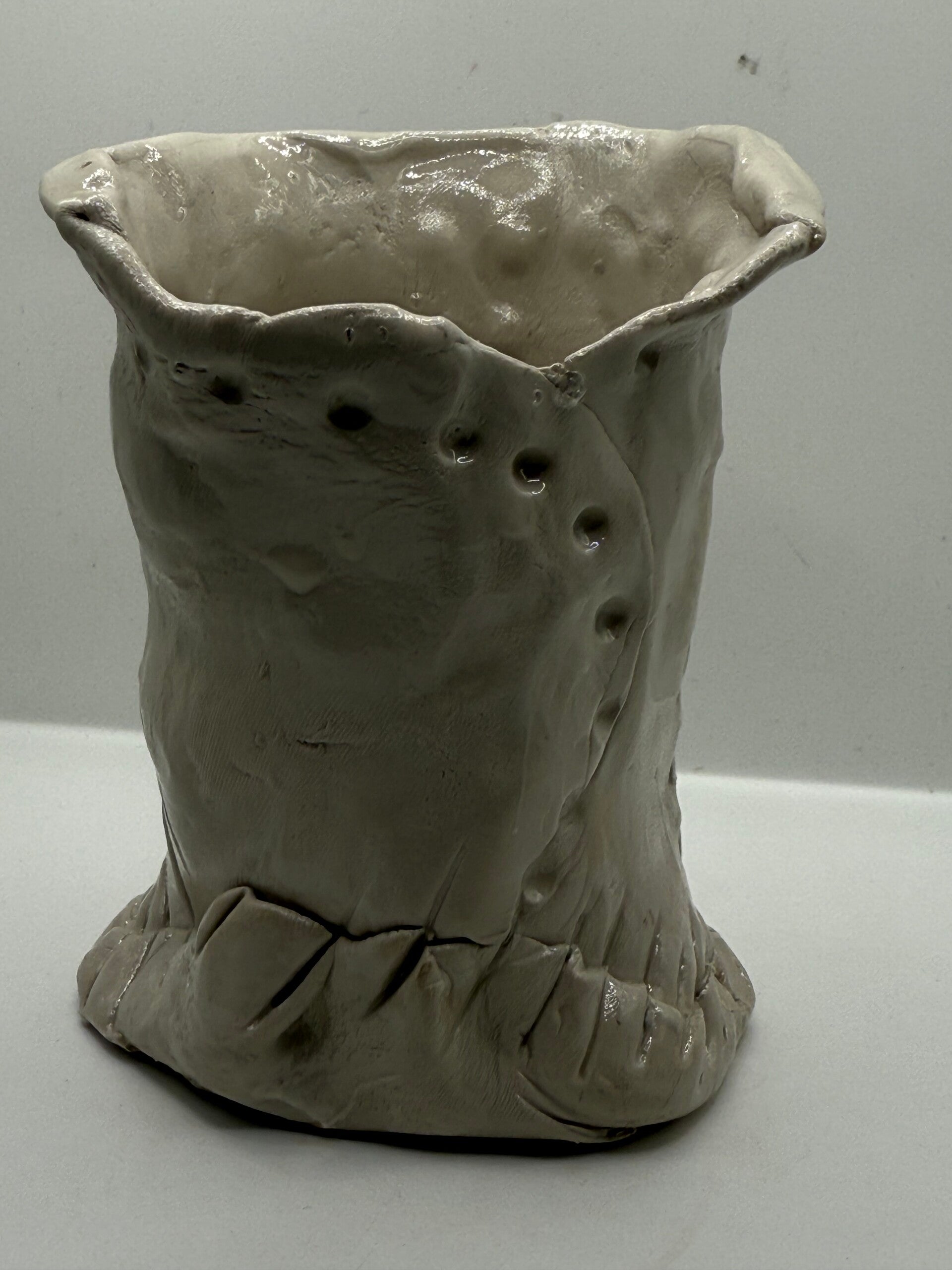
Bound by Necessity is a hand-built clay vessel whose form bears visible seams, punctures, and compressions—evidence of construction through joining rather than refinement. Small perforations travel vertically along the body, suggesting stitching, ventilation, or structural reinforcement. The rim folds inward unevenly, softened by repeated handling, while the thickened base anchors the piece with weight and stability. The surface remains intentionally raw, its muted, earthen glaze recalling ash, stone, and weathered clay. The vessel appears shaped to adapt—capable of holding water, grain, oil, or ritual offerings—its purpose defined by use rather than designation.
Brief Artist Statement (Philosophical & Sociological):
This piece reflects the philosophy that endurance is an act of intelligence. Philosophically, Bound by Necessity speaks to wholeness achieved through joining and repair rather than perfection. The punctures and seams become signs of resilience—proof that fragmentation does not negate function. Sociologically, the vessel references early utilitarian objects crafted by necessity, where resources were scarce and objects were reinforced, reused, and repurposed across generations. It honors a way of living in which making was adaptive, communal, and responsive to survival, and where usefulness was the truest measure of value.

Title: Common Ground Bowl
Description:
Common Ground Bowl is a low, hand-built clay vessel with softly undulating walls and an uneven rim that rises and falls like worn terrain. Its exterior is marked with shallow impressions—square and rounded indentations pressed rhythmically into the surface—while the interior bears subtle punctures and fissures formed through touch and time. The surface is intentionally left raw and weathered, with fine cracks and textural variations that recall sun-dried earth or stone softened by use. The bowl’s form suggests adaptability: it could have held food, seeds, water, tools, or offerings, its purpose shifting with the needs of daily life.
Brief Artist Statement (Philosophical & Sociological):
This piece reflects the philosophy that meaning emerges through use rather than intention. Philosophically, Common Ground Bowl speaks to containment as a shared human act—the quiet agreement to gather, hold, and sustain. Its imperfections acknowledge the fragility of both material and life, embracing erosion as truth rather than failure. Sociologically, the bowl references communal objects central to early societies, where vessels were shared across meals, rituals, and labor, unmarked by ownership or status. It honors a time when survival depended on collective use and when the most ordinary objects became the silent center of human connection.

Title: Seated Form (Bearer of Continuance)
Description:
Seated Form (Bearer of Continuance) is a hand-built ceramic sculpture depicting an abstracted, seated female figure. The body rises vertically from a grounded base, its mass shaped through compression rather than precision. Limbs are implied rather than defined; the torso swells and recedes in soft, organic protrusions, while the head remains featureless and elongated, tilting slightly upward. The glossy, pale surface catches light unevenly, emphasizing curves, folds, and subtle distortions created by the hand. The figure reads simultaneously as human, totemic, and geological—part body, part stone—suggesting a form that could have functioned as idol, marker, fertility symbol, teaching object, or personal talisman.
Brief Artist Statement (Philosophical & Sociological):
Philosophically, this work reflects the earliest human impulse to represent presence rather than likeness. The abstraction rejects individuality in favor of essence—woman not as portrait, but as continuity, grounding, and endurance. The absence of facial detail invites projection, reminding us that meaning once lived in collective understanding rather than personal identity. Sociologically, the piece echoes early figurative objects made before strict divisions between art, ritual, and utility. Such forms were not confined to aesthetic contemplation; they moved between domestic life, spiritual practice, and communal storytelling. Seated Form (Bearer of Continuance) honors a time when the human figure was shaped not to be admired, but to be lived with—held, placed, remembered, and returned to the earth.

Proposed Title:
“The Seated Witness (An Early Remembering)”
Descriptive Statement:
This sculptural form presents a simplified, grounded female figure seated in quiet permanence. The body is rendered with intentional economy—soft planes, compressed proportions, and an emphasized head and torso—suggesting both presence and restraint. The surface bears visible marks of the hand, retaining traces of making rather than concealing them, reinforcing the object’s connection to early human artifact rather than idealized representation. The figure feels simultaneously figurative and symbolic, evoking an ancestral object that might have existed before strict distinctions between art, ritual, and utility.
The posture is inward and self-contained. There is no overt gesture, no narrative action—only being. This stillness invites contemplation rather than observation, positioning the work as an object meant to be encountered slowly, perhaps held, placed, or revered.
Artist Statement (Philosophical & Sociological Perspective):
The Seated Witness draws from the lineage of early human abstraction, where form preceded language and meaning was embedded in use rather than explanation. The figure echoes prehistoric fertility icons, devotional objects, and domestic talismans—forms created not to be displayed, but to exist alongside daily life as carriers of memory, belief, and continuity.
Philosophically, the work explores the idea of presence as truth. By reducing the female form to its essential mass and posture, the sculpture resists idealization and instead affirms embodiment as a fundamental condition of being. The absence of detail is intentional; it allows the figure to function as a vessel for projection, memory, and shared human archetype rather than an individual identity.
Sociologically, the piece reflects on how early societies centered the female form as both symbolic and practical—associated with creation, stability, ritual, and endurance. Unlike contemporary representations shaped by spectacle or consumption, this form reclaims stillness, weight, and anonymity. It suggests a time when objects were not separated into categories of art, religion, or utility, but instead occupied multiple roles simultaneously.
This work asks what has been lost in modern abstraction—not the form itself, but the intimacy between object, maker, and community. It stands as a quiet resistance to excess, honoring simplicity, touch, and the enduring human impulse to shape meaning with the body and the earth.

Title: Vessel of Rising Breath
Object Description
Vessel of Rising Breath is a stylized ceramic form that echoes the silhouette of a pitcher or vase, yet deliberately resists conventional utility. Its perforated body, marked by rhythmic apertures and encircling bands, allows smoke, scent, and light to travel through the form rather than be contained by it. The handle-like extension and flared lip suggest familiarity, while the uneven surface, cracks, and asymmetries reveal a hand-built process rooted in intuition rather than precision. As an incense holder, the piece transforms fire and fragrance into a visual and spatial experience, releasing offerings upward and outward, blurring the boundary between object, air, and ritual.
Brief Artist Statement (Philosophical & Sociological Perspective)
This work reflects my interest in early human objects that existed at the intersection of function, ritual, and survival. I imagine this piece as something that could have belonged anywhere—inside a dwelling, at the threshold of a shelter, or within a communal or ceremonial space. Philosophically, it speaks to humanity’s impulse to mark time, presence, and intention through simple acts like burning herbs or resins. Sociologically, it honors cultures where objects were not specialized or ornamental for status, but adaptable, shared, and embedded in daily life. By refusing strict functionality, the vessel becomes a metaphor for breath, passage, and continuity—an offering to the unseen forces that early civilizations acknowledged long before perfection, hierarchy, or permanence were ideals.

Title: Tide-Worn Reliquary
Description of the Piece:
Tide-Worn Reliquary is a slender, upright vessel whose form appears shaped as much by time as by hand. Its softly flared rim opens unevenly, suggesting an offering rather than containment alone. The blue and earthen surface recalls mineral wash, water, and sky—layers that feel weathered, brushed on like memory rather than decoration. Subtle perforations run along one seam of the body, evoking breath, passage, or the slow release of smoke, while the grounded base anchors the piece in quiet stability. The vessel resists a single function, existing instead as a multipurpose object—capable of holding water, ash, incense, or symbolic offerings—depending on the needs of its user.
Brief Artist Statement (Philosophical & Sociological):
Philosophically, this work reflects impermanence and adaptability—the idea that objects, like people, are shaped by use rather than perfection. Its surface bears evidence of time, touch, and erosion, embracing transformation rather than resisting it. Sociologically, Tide-Worn Reliquary speaks to early communal life, where vessels were essential tools woven into daily survival, ritual, and spirituality. Such objects were not luxury items but shared necessities, carrying meaning through repetition and use. This piece honors the quiet intelligence of those ordinary forms—artifacts that held sustenance, fire, prayer, and memory without distinction or hierarchy.

Title: Womb of Use
Description of the Piece:
Womb of Use is a compact, hollow vessel formed as an abstracted interpretation of female hips—broad, grounded, and weight-bearing. The shape opens subtly at the top, suggesting receptivity rather than display, while the exterior surface carries visible marks, fissures, and uneven contours that speak to hand-formed intention rather than refinement. The warm yellow pigment evokes earth, clay, pollen, and sun—materials and forces essential to early life. Though understanding its form as feminine, the piece resists eroticism; instead, it embodies function, stability, and containment. It could have served as a small storage vessel, offering bowl, ritual container, or personal object, adaptable to the needs of daily survival.
Brief Artist Statement (Philosophical & Sociological):
Philosophically, this work reflects the concept of the body as vessel—a site of holding, endurance, and quiet labor. The abstracted hips symbolize fertility not as idealized beauty, but as structural necessity: the ability to carry, protect, and sustain. Sociologically, Womb of Use references early societies where the female form was revered not for adornment, but for function and continuity of life. Such objects were inseparable from everyday existence—used, reused, worn, and relied upon. This piece honors the anonymous, utilitarian representations of womanhood that existed before ornamentation, hierarchy, or spectacle—when survival itself was sacred.

Title: Spiral of the Everyday
Description of the Piece:
Spiral of the Everyday is a hand-formed cup whose uneven rim and subtly leaning body suggest movement rather than stillness. The saturated turquoise surface evokes water, sky, and mineral pigment, while the red spiral and dotted motif read as a primordial mark—part symbol, part instinctive gesture. The form is tactile and grounded, with a weighted base and visible impressions of the hand, reinforcing its role as a holding vessel rather than a decorative object alone. It could have served many purposes: a drinking cup, a container for herbs or pigment, a ritual offering vessel, or a personal object used daily and repeatedly.
Brief Artist Statement (Philosophical & Sociological):
Philosophically, this piece reflects the idea that meaning emerges through use. The spiral symbolizes cycles—of life, labor, repetition, and return—suggesting that the ordinary act of holding or drinking is itself sacred. Sociologically, Spiral of the Everyday references early communal cultures where objects carried layered significance without hierarchy: a cup could nourish the body, mark a ritual, or hold memory. Such vessels were not owned as luxury but shared as necessity. This work honors those humble forms that bridged survival and symbolism, reminding us that the everyday was once inseparable from the spiritual.

Title: Bowl of the Uncounted
Description of the Piece:
Bowl of the Uncounted is a low, open vessel with a thick, uneven rim that folds inward and outward like terrain shaped by erosion. Its surface is marked with small, deliberate perforations arranged in loose grids—not ornamental, but communicative, as if tallying days, portions, breaths, or offerings. The ochre-yellow tone evokes sun-dried earth, grain, and raw pigment, while subtle cracks and rough seams reveal the pressures of making and time. The bowl’s interior is expansive yet intimate, suited to holding food, seeds, ash, tools, or sacred remnants. It feels handled, necessary, and lived with—an object meant to be reached for repeatedly rather than admired from afar.
Brief Artist Statement (Philosophical & Sociological):
Philosophically, this piece speaks to containment as an act of care. To hold is to preserve, to pause loss, to give form to survival. The imperfections and markings acknowledge that usefulness does not require symmetry or permanence. Sociologically, Bowl of the Uncounted references early communal life, where bowls were central to shared existence—used for eating, storing, preparing, and ritual without distinction. The perforations suggest record-keeping before language, value before currency, and memory before history. This work honors the anonymous, utilitarian vessels of ordinary people—objects that sustained life quietly, without adornment or authorship, yet carried the weight of daily survival and collective continuity.
Natural primitive and earthy ancient like pieces with a modern twist
If you are seeking natural, primitive, and earthy ancient-like pieces with a modern twist, you've come to the right place. AdiaEloraRothschild presents the Primitive Series, designed to resonate with those who appreciate raw form and the beauty of imperfection.


Hand made by artist with no modern tools
What makes the Primitive Series truly unique is that each piece is lovingly handcrafted by Adia Elora Rothschild without the use of modern tools. This ensures every item carries the distinct mark of the artist's hand and a connection to ancient traditions.